

Your next utility bill? Intelligence.
AI labs want to sell us intelligence on a meter. Do they have it? Where did they get it from?

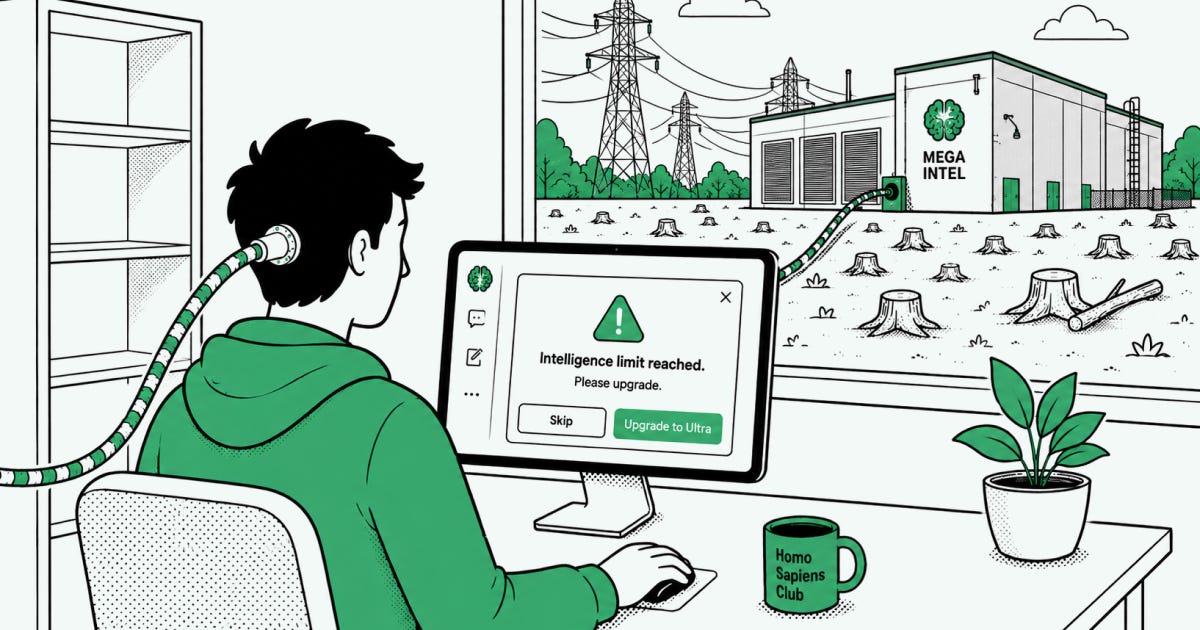
AI companies are pitching themselves as providers of intelligence. According to Sam Altman, OpenAI envisions a future in which intelligence is a utility like electricity or water, and people buy it from them on a meter.
It looks like we’re headed for an Intelligence-as-a-Service future, and we need to discuss that. We may never know if Sam left the “artificial” part out on purpose. Maybe we are already at a stage where the difference between artificial and natural intelligence is not as relevant as we thought — I suspect, there are people who would like us not to find it relevant at all.
So, let’s discuss the service being provided: intelligence.
What is intelligence?
According to the American Psychological Association (APA), “intelligence is the ability to derive information, learn from experience, adapt to the environment, understand, and correctly apply reason.” When we think about intelligence, we’re most certainly thinking about the human kind, but let’s not forget that we are not the only beings that show intelligence: Great apes and corvids solve problems, dogs developed advanced social awareness, and even invertebrates, like octopuses, show curiosity and learn how to use tools. So, not only is intelligence not a specific human trait, but the way we define and measure it is probably biased. We anthropomorphized intelligence. If seagulls got to define intelligence, it would probably be something very different, and we, humans, would not fare well. Right now, by our own standards, it seems we are still the most intelligent beings around. It’s not a matter of quantity or raw power. Human cognition seems special because of an expanded, domain‑general information‑processing capacity that supports language, abstract reasoning, massive memory, and rich conceptual systems. We are flexible, all-arounders.
Who’s to say that the APA’s definition still stands? I do not fear a world in which the definition of intelligence will be dictated by seagulls. However, a world where intelligence is defined by an entity that has become smarter than us may not be so distant. Much, much closer, may be a world where intelligence is defined by trillion-dollar companies that have unlimited intelligence to sell. So, when we talk about intelligence, we need to be mindful that the concept is tied to a set of circumstances that may change for better or worse.
Do we need intelligence?
Of course. Right? Well, it depends. Needed by whom? For what? Given that many beings have developed intelligence, it appears to be needed not just by humans but by other organisms in nature, including plants. Intelligence provides clear survival advantages in foraging, predation, and social behavior, and, to maintain some balance across numerous contingencies, some argue that a natural super-intelligence must be present.
When we say that humans need intelligence, we do so knowing that it has allowed us to survive, and we believe that what worked so well must continue to yield the same results in the future. However, we cannot be certain of that. Some work questions whether current human intelligence remains adaptive in modern conditions (e.g., climate change, huge populations), to which our minds and bodies might not have had the time to adapt. May it be that the same capacities that once conferred survival value now threaten long‑term survival? Along these lines, some argue that only behavior that preserves and enhances life should count as truly intelligent; intelligence that drives self‑destruction is, by definition, failing its purpose. So, are we still intelligent? Do our paleolithic brains still represent an advantage in the modern world? Also, intelligence seems necessary for survival, but do we need it to come from humans?
How intelligent are we? And the machines?
We tend to overestimate our cognitive abilities. Also, we’re not getting smarter: a recent review of worldwide IQ trends found positive gains (Flynn effects) mainly in less economically developed countries, but trivial or even negative trends in the most advanced countries. Despite this, it’s a fact that primates — which differ from us genetically only slightly — are far behind us. We can therefore legitimately qualify humans, compared with other animals, as highly intelligent.
Concerning AI, it’s a different story. We lose in speed. We lose in scale. AI loses in creativity, flexible reasoning, emotional intelligence, ethical judgment, and holistic understanding. Human intelligence is broadly general and context‑sensitive, whereas current AI is mostly narrow. Still, today, AI can already match or approach human performance in some cognitive‑like tasks (especially decision‑making).
So, it looks like we still have the best brains out there. By our own standards. However, the anthropomorphization that may be blindsiding us when evaluating intelligence in non-human nature may be doing the exact same thing when it comes to evaluating AI. What would happen if we started using AI to design the tests that evaluate human intelligence?
We can argue that it’s irrelevant who has the most cognitive capacity. AI is advertised as a pocket-PhD. Isn’t that good enough? Most days, we don’t choose state-of-the-art. We’re not only eating in Michelin five-starred restaurants, driving the best car ever made, or going to the best doctor on the planet. We settle on the good-enough: the hairdresser that’s nearby, the auto-shop that’s not too expensive, the plumber that takes the call. The same is happening with intelligence. People are using the good-enough, always-available version of it.
Right now, the gap in raw capability may not be unsettling, but what we’re optimizing for is. It seems we are better than machines at things we don’t value enough or we don’t have time to address. In business and everyday life, ethics and emotions are regarded as nice-to-haves rather than critical. Speedy action, where we already lose to AI, is rewarded. If we keep optimizing for those metrics, especially for productivity, not caring for the nuances that make us good at understanding other humans, what do we gain from having these skills in the first place?
Is buying intelligence outrageous?
Yes, knowledge should be free and open. It isn’t, but that’s not OpenAI’s or any other AI lab’s fault.
Intelligence (and the knowledge that may express it) has never been fully free or equally available. In a study of 55 traditional cultures, it was found that ethnoscientific expertise (e.g., medicinal and subsistence knowledge) was often specialized and sometimes deliberately kept secret or proprietary, especially in medicine, whereas motor and subsistence skills were more openly taught. In the modern world, historical overviews of science and information emphasize that knowledge has long been structured by institutions, specialization, and unequal distribution rather than open access. I’ve spent a lot of money buying intelligence: Internet, books, schools and courses, culture, and relationships. You probably did the same. So, why does it feel shocking to buy intelligence from an AI lab, while indebting ourselves when pursuing college feels like an empowering milestone? Yes, a degree takes time and effort — I’ll get back to this important nuance — but let’s not pretend that academia isn’t a supermarket.
So, buying intelligence is nothing new. For ages, we’ve been buying it from organizations, but also from others: we consult and pay a lawyer, a doctor, or a mechanic because they know something that we don’t about a specific law, ache, or car part. Those experts got their knowledge somewhere. What’s different in the age of AI is the distribution. We may argue that intelligence is not very well distributed (jokes aside), but it is distributed. There are smart people in every corner of the world, doing all kinds of jobs, with diverse backgrounds and socioeconomic statuses. Intelligence is not country-specific. It is not (just) a white man’s privilege. It’s not in the hands of half a dozen companies. But that can change. If we displace intelligence from schools, studios, libraries, and all those places and circumstances where we grow it organically to put it in a data center, behind closed doors and paywalls, we’re concentrating it. That’s not removing barriers or widening access. It’s exactly the opposite.
Devaluing intelligence while exacerbating privilege.
The implications for the “knowledge society“ are immense. What happens if and when a lot of people stop going to the doctor because they think they have access to the same knowledge? As soon as a kid learns to read and write, they can create and customize as many AI teachers as they want. Do schools, as we know them today, still make sense? If knowledge (or the illusion of it) is everywhere, what happens to the teacher, the lawyer, and so many other experts? It’s not just that we devalue knowledge and jobs. Does a society that stops valuing experts, pays them poorly, and ultimately thinks they aren’t needed, still produce them?
By paying for intelligence, we paradoxically risk devaluing it. With a subscription model, we may be equating intelligence and knowledge with content. For some, especially those with money, it’s something they would pay for, like everything else. More money gives access to better AI models, so better “intelligence”. This shifts the focus from wanting to be intelligent to wanting to access intelligence.
Buying what was stolen is outrageous.
When OpenAI, Anthropic, Google, Meta, and the rest of the major AI labs were building their Large Language Models (LLMs), they went to the Internet and copied what they needed: websites, books, videos, code, poems, fiction, photography, academic papers, illustrations, Reddit threads, Wikipedia entries, news articles, music lyrics, and so much more.
The Common Crawl dataset, one of the primary sources used to train LLMs, includes petabytes of stolen content. Books3, a widely used dataset, contains over 196,000 books whose authors were never contacted or paid. The LAION image dataset, used to train image generation models, scraped hundreds of millions of images from artists, photographers, and designers. Some visual artists were very surprised to see chatbots generating images that looked like their studio work. Companies that complained about piracy for decades rely on classic pirate sources for model training.
Stolen property being publicly available for free is not good, but what we got is much worse. If someone went to our garden, picked up all our flowers, and then sold them back to us, we would get mad, and that thief would probably be in jail. Those companies ingested a large part of the world’s knowledge, built tools that most humans cannot afford or audit, and now they want to sell our words back to us. Via subscription. Paying per token is, roughly, paying per word.
OpenAI was initially structured as a non-profit with the mission “to advance digital intelligence in the way that is most likely to benefit humanity as a whole, unconstrained by a need to generate financial return”. That’s history.
Intelligence is not wind.
When Altman frames intelligence as just another utility, he’s trying to legitimize the business model. When we buy water, we’re purchasing something that was made outside the solar system, got trapped on Earth, and cycles autonomously. We can capture it when it rains, when it gets trapped in a lake, or when it springs to the surface. However, it doesn’t bottle itself, and it doesn’t flow magically to our kitchen tap. The same applies to wind. We know it’s energy, but wind alone doesn’t light a lightbulb. No one built water. Wind, it’s not mine or yours. But we sell it and buy it. We sell rights to explore reservoirs, we pay for treatment and conversion, transport, packaging, and even marketing.
Doing the same with intelligence, as Altman proposes, doesn’t seem so far-fetched. But there’s a key problem with that. Although intelligence takes various forms in nature, when it comes to the human aspect of it, the knowledge it produces doesn’t come out of thin air. Art doesn’t fall from the sky, books don’t come out of the ground like weeds. So it’s not just the infrastructure they’re selling. It’s the content itself. What got stolen was creation: books that took ages to be written because the author needed decades of living a life and getting experience in writing; research that gathered scientists from all over the world and was funded by the public; and illustrations that got famous not only because they were beautiful, but also because of their unique style, a fingerprint of the creative mind of that artist.
Collective human knowledge, the building of our shared library, is an ongoing effort: almost 120 billion homo sapiens have already made their contributions in the last 200,000 years. It’s not wind.
Ironically, intelligence is a muscle.
Steve Martin had a particularly difficult time learning to play the banjo, but he never gave up. He thought to himself, “Well, if I just stick with it, one day I’ll be saying, I’ve been playing for 40 years”. In the last five decades, he got 5 Grammy Awards and 15 Grammy Nominations. We know the importance of practice: someone who starts running becomes faster and develops endurance within a month, someone who lifts weights develops muscles and strength. It’s the same with specific cognitive skills, whether it’s reading, writing, practicing a foreign language, or thinking about our thinking. The abilities to derive information, learn from experience, adapt to the environment, understand, and correctly apply reason — APA’s definition of intelligence — take time and resources to develop. It’s not something we do once, and then we become intelligent for life. It’s the continuous practice that can make us proficient. But it’s not intelligence alone. A doctor doesn’t become a good one by memorizing an anatomy book. That’s exactly the kind of intelligence AI labs are selling right now: snapshots from that anatomy book. Expertise, experience, and judgment, combined, make good doctors and experts in any field. No subscription provides that.
The case for public AI
AI keeps getting compared to electricity. Sometimes, because of its impact, and now, also because of its business model. Maybe we should treat AI like electricity. Managing intelligence like electricity could actually be good. Altman was focusing on the revenue side, but there’s more to it when it comes to utilities. No single country or company manages or owns electricity. It is heavily regulated, and prices are capped, sometimes even subsidized. Electricity infrastructure — at least the transmission grid — is publicly owned or tightly regulated in most countries, particularly in Europe. Competition is abundant and fierce. If the metaphor backfires, it would eventually lead OpenAI to operate under a completely different set of rules: regulated, with government oversight and thin margins. Or state-owned: the company, the tech, the data centers, all of it. While the Robin Hood model is not a perfect one, tech built on collective intelligence, humanity’s accumulated knowledge, that runs and feasts on the planet’s resources, should “benefit humanity as a whole, unconstrained by a need to generate financial return”, paraphrasing OpenAI.
The good news is that Public AI is a thing. There is Public AI from Switzerland (an open deployment service intended to make public and sovereign AI models more accessible to citizens), Spain’s ALIA (Europe’s first public, open, and multilingual AI infrastructure), Singapore SEA-LION (a family of efficient, open-source, multilingual, multimodal language models designed to understand Southeast Asia’s diverse languages, cultures, and contexts), just to name a few. You can read more about public AI developments at Open Future’s website, the Public AI newsletter, or in the Global Rise of Public AI report.
While public AI initiatives are not perfect — outsourced provision can help cement oligopolies by marketing a “local” tool where, in fact, the AI provider is a major foreign AI lab — these are steps in the right direction. They’re trying to build fairer options by using open datasets and open-source license models, harvesting less user data, leveraging clean energy resources, and accounting for local specificities. As AI becomes infrastructure, we’re probably going to use it in a wide range of scenarios. It’s good to have a few (saner) options. And if we’re going to borrow or buy “intelligence” from these providers, maybe helping the local economy is preferable to the oligopoly alternative.
What can we do as individuals?
Do not mistake data for intelligence. LLMs provide answers based on statistical analysis, as humans do. But that’s not all that we do. Our unique capacities are a mix of intelligence, experience, and judgment. Current models spit out what they have ingested, based on probabilities: the probability that it is accurate and the probability that we like the answer. Often, they favor the latter (sycophancy). When using AI, be aware of that.
Build “muscle”. Running is not the same as driving a car. They both get you somewhere different, but only running makes us live better and longer. So, don’t reach for AI tools as soon as you need to think about something. Do the thinking. Make mistakes. Gain experience(s). If you don’t use it, you’ll lose it. I’m not saying “don’t use AI”. Use it if you must, but be mindful that not all use cases have the same consequences. Using AI for automation is much different from using it for reflection.
Do not mistake access for capacity. Having access to data may be helpful on trivia night, but that’s just storage and retrieval. Having a library as a next-door neighbor doesn’t make us smarter. Reading the books, discussing them, and applying that knowledge critically does. When you get data from an AI model, question it, study it, and, if verified, apply it consciously. Don’t delegate every part of your writing or research. Don’t stick to copy-paste.
Support public AI. Probably, it never crossed our minds that we could contribute to public AI. But we can. We can start by using public AI products, if available in our region. While using them, we may help test their functionalities and interface. We can go even deeper: developing code, donating money or hardware, joining or managing communities.
Choose ethically. By paying for tokens, we’re actually paying for words. If those words were stolen, then you may want to take a (ethical) stand on that.
What does this mean for organizations?
Do not mistake productivity with competence. AI helps us to do things that we are incapable of doing on our own. In some cases, it’s not just helping anymore. It’s replacing. What happens if AI becomes unavailable? Is your organization still able to meet the agreed deadlines or deliver the product/service at all? Be honest about your use of AI and don’t take credit for something that your organization didn’t do.
Mitigate Intelligence-as-a-Service sovereignty risk. Intelligence that comes from a data center is a dependency like any other. These product offerings are subject to price increases, downtime, changes in terms, changes in how they work, and state affairs. Prepare for a scenario where the AI your business relies on may change and, if possible, choose one that’s more reliable. There are open-source and local-first models, like Ollama, or privacy-focused like Lumo.
Avoid legal and reputational risks. Data obtained without permission was used to train most AI models. If it ends up in a report or your codebase, would you notice? License laundering is already a problem. Do you feel comfortable copying others’ work without fair compensation, enabling predatory business models? Do you want something you don’t understand baked into your products? These things can hurt your customers and your reputation.
Train people, not (just) models. Human potential is still unmatched. Companies hire people because they expect to extract more value from them than what they pay for. That value doesn’t come out of nowhere. It was a long-term investment by society, families, and individuals. The way you keep getting value is by continued investment in people. It’s good for the business and for themselves. If you cut in hiring and training and move that budget to AI subscriptions, you’re actually deskilling your people and your business.
Support Public AI. If you worry about digital sovereignty, then you should embrace open-source models and public AI. It’s cheaper too. As a business, you can also be involved in developing code, managing teams and events, and donating money, computing power, and brain power from your team. There are many opportunities for sponsorship and partnership.
Unconstrained, as they promised.
Well, intelligence is not rare, but, as far as we know, ours is. Yes, we are biased, and maybe the intelligence that brought us here might not be as useful today as it was before, or it may not be enough to solve humanity’s most challenging issues. The answer to that? We keep developing it. One reason we may need it is to distinguish intelligence from snake oil; what’s stored in data centers is not intelligence.
It also doesn’t need to be intelligence to be useful. It is already useful. Maybe we’re headed towards hybrid or symbiotic human–AI systems, where AI handles complexity, scale, and repetitive analysis (which it does best), while we provide context, judgment, creativity, and ethical oversight — which only humans are capable of. Is it intelligent to discard a technology that is better than us in some cognitive tasks, just because it’s not human?
No matter how it all pans out, we should not let a company tell us what intelligence is and how we’re going to get it. When it comes to subscribing to a service we pay for on a meter, we must be smart about it: we need to know what it is, what it is good for, whether we need it, whether it hurts us or others by using it, or even by accepting it.
We also have other options.
AI feeds on human knowledge.
It was built by human intelligence and sweat.
Maybe we should make AI public and get rid of the meter.
Great article, thanks.
"By paying for intelligence, we paradoxically risk devaluing it." I found your takes, particularly around the problematic idea of paying for intelligence, thoughtful and interesting. Really excellent read.